
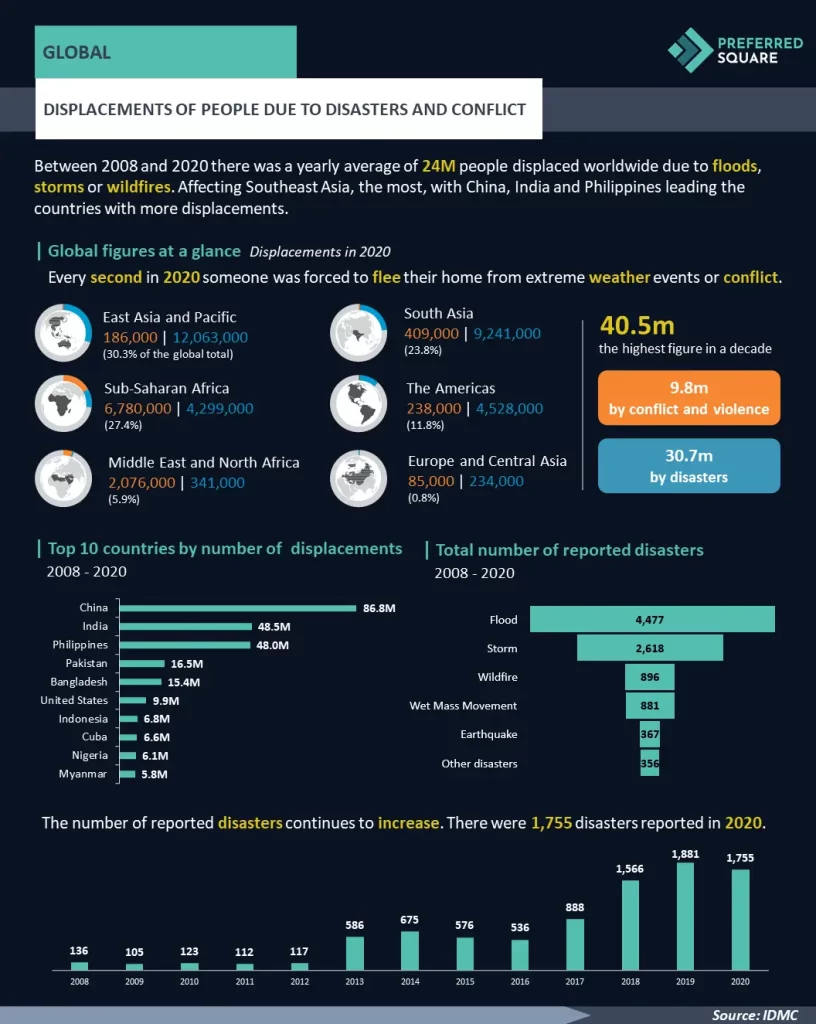
Conflicts and natural disasters forced someone to flee within their own country every second of last year, pushing the number of people living in internal displacement to a record high. This came despite strict restrictions on movement imposed around the globe in efforts to halt the spread of COVID-19, which observers had expected to push down displacement numbers last year.
But 2020 was also marked by intense storms, persistent conflicts and explosions of violence, forcing 40.5 million people to become newly displaced within their countries.
Weather-related events were responsible for 98 per cent of all disaster displacement recorded in 2020. Intense cyclones, monsoon rains and floods hit highly exposed and densely populated areas in South Asia and East Asia and the Pacific, including China, the Philippines and Bangladesh. The Atlantic hurricane season was the most active on record and extended rainy seasons across the Middle East and sub-Saharan Africa uprooted millions more. In addition, nearly 10 million of those newly displaced last year were fleeing conflicts and violence, the report said.
The report added that escalating violence and the expansion of armed groups in Ethiopia, Mozambique and Burkina Faso had fuelled some of the world’s fastest-growing displacement crises last year.
It also warned that a convergence of conflicts and natural disasters was making the problem worse, with 95 per cent of last year’s new conflict displacements occurring in countries vulnerable to the impacts of climate change.
Disaster displacement and the role of climate change:
The role that climate change plays in driving disaster displacement is also often seen as a direct one, but the evidence does not support this hypothesis. Climate change has been proven to make certain hazards in some regions more frequent and intense. Extreme weather events such as floods, storms and drought account for more than 89 per cent of all disaster displacement
There is broad agreement among scientists that climate change in combination with other factors is likely to increase future displacement. 410 Research shows that even if the world’s population were to remain at its current level, the risk of flood-related displacement would increase by more than 50 per cent with each degree of global warming.