
Management consulting has always operated in a world of complexity. Traditionally, firms relied on human intellect and structured frameworks to parse ambiguous problems, synthesise data and deliver recommendations. But the next chapter of consulting is being written by AI that not only generates content but acts on it.
Agnetic AI systems autonomous software agents that interpret objectives, plan multi step workflows, execute tasks and learn from feedback are moving the profession toward continuous, always on strategy. While generative AI introduced the ability to draft text or code, agentic AI brings decision making and coordination within reach. This article traces the evolution from framework-driven practice through augmented intelligence to the emerging world of autonomous agents, offering insights into how consultants are using these tools today and where the profession may be headed next.
1. A Brief History of Consulting: Human-Centric and Framework-Driven
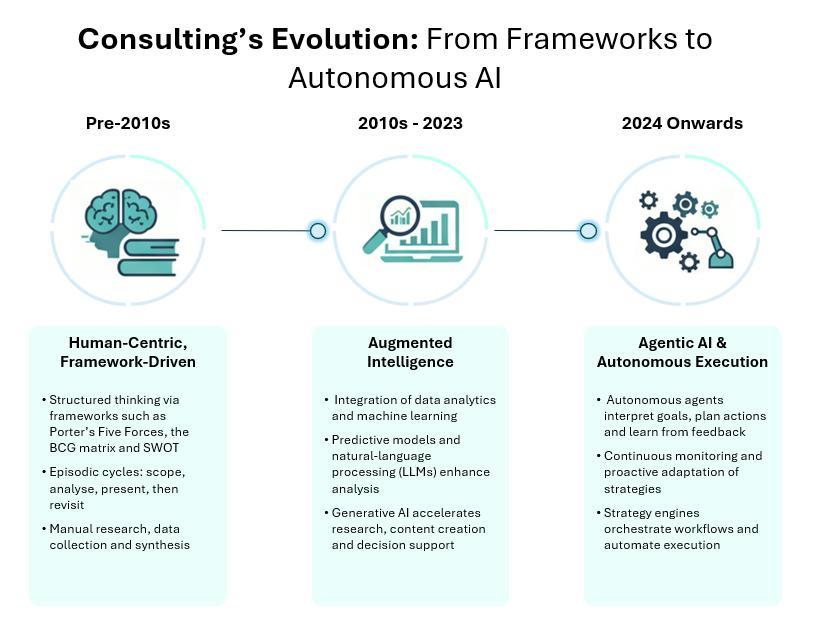
Consulting’s roots lie in structured thinking. Classic frameworks such as Porter’s Five Forces, the BCG matrix and SWOT analysis provided simple lenses for ordering messy business realities. Consultants would immerse themselves in a client’s operations, conduct interviews, run spreadsheet models and build slide decks to guide boardroom decisions. Technology helped with number crunching and presentations, but the value came from human expertise and judgement.
Projects typically ran in episodic cycles: commission a study, collect data, analyse, present findings, decide, implement, then review weeks or months later. This cadence suited a world where markets moved relatively slowly. Consultants were valued for independence, an outsider’s eye and the ability to break down big questions into component parts.
Why frameworks were powerful:
- They distilled complex environments into digestible perspectives
- They provided a common vocabulary for clients and consultants
- They embedded rigour and discipline into analysis
However, as business landscapes accelerated, the limitations of these frameworks became clear. They captured a moment in time but could not keep pace with a world shaped by digital disruption, geopolitical shocks and global crises. Planning cycles compressed, and clients increasingly demanded continuous insight and more frequent recalibration.
2. The First Wave of AI in Consulting: Augmented Intelligence
Around the late 2010s and early 2020s, consultants began incorporating machine learning and data analytics into their workflows. Predictive models helped forecast demand or segment customers. Natural language processing accelerated document review and competitive research. By 2023-2024, generative AI tools burst into mainstream consulting workflows, enabling large language models (LLMs) to draft memos, summarise interviews and simulate scenario narratives within seconds.
However, the dominant pattern remained reactive. AI answered questions but rarely asked them. It created content but did not decide how that content should be used. Humans still orchestrated the workflow: selecting tools, integrating data, overseeing quality and determining next steps. The result was faster throughout but not a fundamentally different decision dynamic.
Examples of generative AI in consulting today
- Research automation: A 2025 survey of consulting executives found that 58% cite research and summarisation as their leading use case for agentic AI. Generative models can crawl thousands of documents, news articles and transcripts to produce concise briefs
- Proposal and pitch drafting: AI assists in creating proposals or pitch decks by incorporating best-practice templates and tailoring content to specific clients
- Decision support: Models synthesise market data and internal insights to help consultants act quickly and confidently
- Client personalisation: AI recommends strategies based on a client’s past interactions, preferences and goals
The productivity gains are real. Firms using agentic AI report a 35% reduction in decision making time, a 42% improvement in resource allocation efficiency and a 28% boost in employee satisfaction. But most deployments still operate under human supervision; the AI is assistive, not autonomous.
3. Understanding the Two AIs: Generative vs Agentic
To understand where consulting is headed, it’s useful to distinguish between two broad categories of AI:
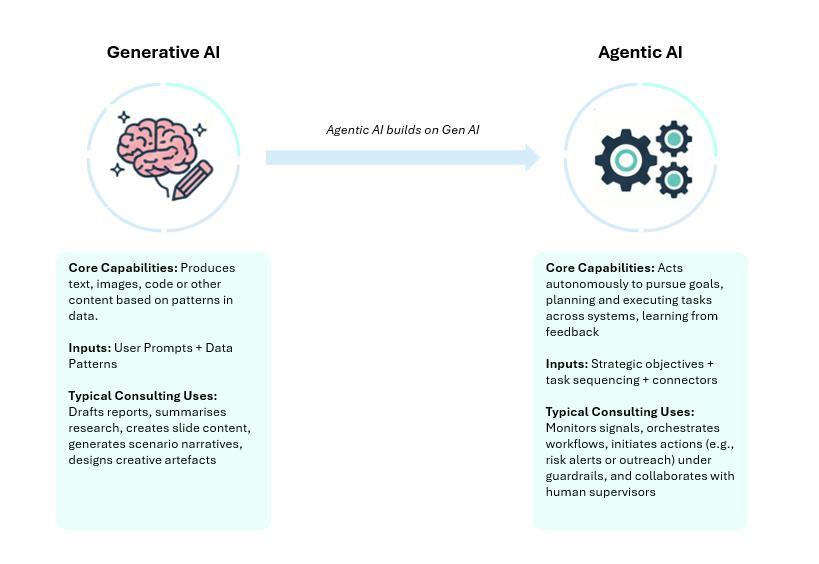
Generative AI is reactive, it produces content in response to prompts. Tools such as ChatGPT, GitHub Copilot or DALL·E draft reports, images or code but require a human to define the task. Agentic AI, by contrast, is built for autonomous execution: it initiates tasks aligned with a goal, adapts based on live data and makes decisions in real time. Key features include autonomy, goal oriented execution, adaptability, multi agent collaboration and data driven reasoning. Think of generative AI as a content writer, whereas agentic AI acts like a programme manager who coordinates teams and workflows. Agents interpret objectives, design and sequence subtasks across systems (e.g., CRM systems, databases, communication apps), learn from feedback and decide when and whether to act.
4. The Rise of Agentic AI: Autonomous Strategy Engines
Agentic AI is now emerging as the next frontier. The idea isn’t for AI to simply generate outputs but to drive workflows. Here’s what sets agentic systems apart:
- Initiative: Agents don’t wait for prompts. They interpret strategic objectives and decide what tasks to perform
- Planning and coordination: They break goals into sub-goals, coordinate multiple subtasks (often performed by specialised agents) and sequence actions across systems
- Memory and learning: They remember past interactions and outcomes, using that context to refine future actions
- Collaboration and escalation: Agents collaborate with human supervisors and other agents, pausing or escalating decisions when confidence is low or stakes are high
The autonomy of these systems means that consultants will soon have digital team members capable of executing research, analysis and outreach with minimal oversight. This promises to collapse the distance between intent and impact, moving intelligence closer to the decision point.
Real world adoption and benefits
Agentic AI isn’t just a concept; consulting firms of all sizes are deploying agents to automate research, monitor risks, develop proposals and engage clients. Boutique consultants leverage agents as digital assistants that monitor industry publications and competitor moves, produce weekly briefings and generate competitive intelligence for proposals. These digital “armies” handle time consuming research and document formatting so consultants can concentrate on high value judgement. Boutique AI consultancies are also building custom agentic systems for clients; one firm developed an agent with advanced NLP capabilities that verifies customer accounts, retrieves personalised data and now manages over 70% of support queries, reducing wait times and freeing human agents.
At the other end of the spectrum, leading consultancies are scaling agentic platforms across thousands of users. For example:
- EY has deployed 150 AI agents in its tax division; these agents monitor regulatory changes, draft filings and flag compliance risks
- Deloitte’s Zora platform is projected to reduce costs by 25% and boost productivity by 40%
- McKinsey’s internal AI assistant, Lilli, is used by 80% of its consultants and saves around 30% of their time
Overall, organisations adopting agentic AI report tangible benefits: 35% shorter decision cycles, 42% better resource allocation and a 28% boost in employee satisfaction.
New capabilities unlocked
Agentic AI extends the value of generative AI in several ways:
-
1. Velocity– Strategy at the speed of reality : Agents continuously monitor market signals; competitor moves and operational data. They compress the cycle from sensing to decision to action, enabling real-time adaptation
-
2. Coverage– Seeing more, sooner : Human teams can only track a limited set of indicators. Agents can ingest vast amounts of structured and unstructured data, surface anomalies and prioritise issues for consultants
-
3. Consistency– Fewer errors, clearer rationale : Agents follow defined processes, reducing variability introduced by fatigue or bias. They attach rationale and impact estimates to each recommendation, creating an audit trail
-
4. Explainability by design– Confidence built in : Trust is not a by-product; it is embedded. Agents provide explanations of their reasoning, assumptions and rejected alternatives, building stakeholder confidence
-
5. Guardrails and governance– Autonomy with control : Agents operate within policy and compliance thresholds. They pause at boundaries, invite human review where stakes are high and roll back actions when outcomes diverge from intent
-
6. Resilience– Designed for variability : Agents learn from weak signals and adapt to new regimes without waiting for periodic strategic refreshes. They treat volatility as normal, not exceptional, strengthening organisational resilience
5. What’s Driving the Shift?, Pressures and Opportunities
Several factors are pushing consulting towards greater autonomy:
5.1 Rising decision density
Clients must make more decisions in less time. Global events, digital disruption and competitive intensity compress strategic cycles. Agentic AI helps by maintaining continuous situational awareness and initiating actions promptly.
5.2 Talent scarcity and cost pressures
Experienced consultants are expensive and in high demand. Automating routine research and analysis allows firms to deploy human expertise where it adds the most value – judgment, storytelling, relationship building – while meeting client expectations for speed and cost efficiency.
5.3 Competitive differentiation and client expectations
Clients increasingly expect data-driven, always on insight. Firms that embed agentic AI into their service models can offer proactive risk monitoring, personalised recommendations and continuous engagement, moving from episodic projects to subscription like relationships.
5.4 Technology maturity
Advances in large language models, multi-agent systems and orchestration platforms mean it is now feasible to coordinate complex tasks across disparate tools. The agentic tech stack typically involves five layers:
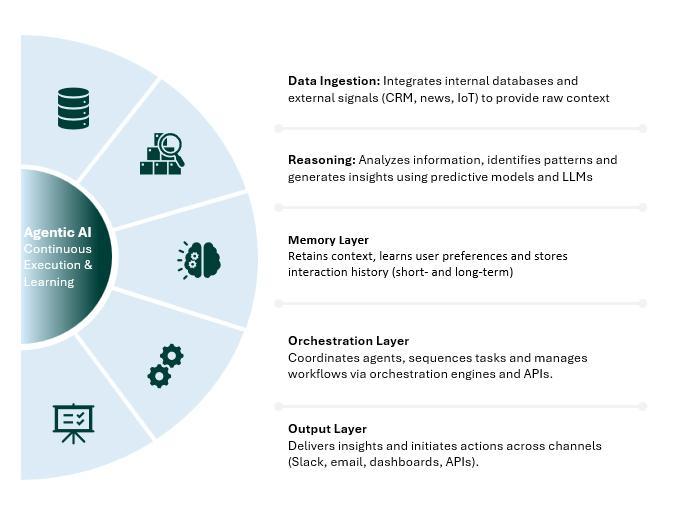
Without robust infrastructure, agents struggle to produce accurate results. Building this stack is therefore a priority for firms adopting agentic AI.
6. Challenges and Risks: Why Adoption Isn’t Easy
While the benefits are compelling, adoption has been slower than the hype suggests. Deloitte’s 2025 survey of AI leaders found that the top barriers to agentic AI adoption include unclear use cases, integration hurdles, governance concerns and talent shortages.
6.1 Unclear business value
Many organisations struggle to translate agentic AI from theory into measurable ROI. The technology’s potential seems boundless, making it hard to prioritise specific applications. When objectives are vague, pilot projects don’t scale, and funding dries up. Consultants need to identify problems where automation generates clear value – such as risk monitoring, compliance reporting or repetitive research tasks.
6.2 Integration with legacy systems
Agentic AI thrives in dynamic, connected environments, but enterprises often operate on rigid legacy infrastructure. Integrating agents with outdated systems requires platform modernisation, API-driven integration and process re-engineering. Without integration, agents cannot access the data or tools necessary to make decisions.
6.3 Governance, risk and compliance
Delegating decisions to AI raises concerns about safety, bias, privacy and explainability. Regulations specific to agentic AI are still emerging, leaving companies uncertain about compliance. Deloitte notes that organisations must establish internal governance models, policies and safeguards for human-AI collaboration while regulation catches up.
6.4 Lack of technical expertise
Deploying agentic systems requires capabilities in adaptive learning, agent orchestration, simulation and enterprise integration. Firms without in-house expertise risk vendor dependence and slower adoption. The LexisNexis survey shows 92% of management consultants believe their employees need new capabilities to keep up with AI. Accordingly, 42% of consulting firms have already implemented advanced AI training.
6.5 Cultural resistance and communication
Change management is hard. Consultants worry about job security or fear being replaced. Clients may distrust “black box” recommendations. LexisNexis notes that 54% of consultants surveyed stress the importance of transparent AI systems. Communication about how AI is used, what guardrails exist and who remains accountable is critical to overcoming resistance.
6.6 Environmental and ethical concerns
AI systems consume significant energy. Deloitte’s 2025 TMT report warns that energy consumption of global data centres could double to 1,065 terawatt hours by 2030 due to AI training. Moreover, algorithmic bias can perpetuate discrimination if data are not diverse. Responsible adoption requires sustainable practices and inclusive datasets.
7. The Skills Shift: Reimagining the Consultant’s Role
As AI takes on more of the execution, the human edge in consulting moves up the value chain:
- Engineering-first mindset: Consultants must understand how AI works and how to use it responsibly, though they may not need to code
- Data and AI literacy: New roles are emerging for AI trainers, data specialists and governance experts
- Judgement and ethics: Human expertise will focus on defining objectives, setting guardrails and resolving trade-offs when values conflict
- Storytelling and influence: Consultants will spend more time synthesising machine-generated insights into narratives that persuade clients and stakeholders
The LexisNexis survey emphasises the need for responsible use: clients expect transparency, staff need reassurance and regulators demand compliance. Best practices include establishing audit trails, human oversight and clear communications on data use.
What Tomorrow Might Look Like: Predictions and Emerging Trends
8.1 Adoption forecasts
According to Deloitte’s 2025 TMT predictions (as summarised by Incepta Solutions), 25% of enterprises using generative AI are expected to deploy AI agents by 2025, rising to 50% by 2027. These agents already perform tasks like data analysis, customer service and fraud detection.
At the hardware level, AI capabilities are becoming ubiquitous: the same report projects that 50% of laptops and 30% of smartphones shipped in 2025 will include on device generative AI processors. This means AI will be able to run offline, enabling personalised, real-time interactions.
8.2 The end of the gender gap in AI usage
By 2025, women’s adoption of generative AI in the U.S. is projected to equal or surpass men’s. This points to greater inclusivity, but global gaps remain. Companies must ensure their models are trained on diverse data to avoid perpetuating biases.
8.3 Data as a strategic asset
Quality data is the lifeblood of generative and agentic AI. Incepta’s analysis recommends that firms invest in diverse, accurate and secure datasets, implement strong encryption and conduct regular audits. Without high-quality data, even the most sophisticated agents will produce unreliable outcomes.
8.4 Integration ecosystems and partnerships
Adopting generative and agentic AI isn’t plug and play. Organisations will increasingly partner with technology platforms to integrate new capabilities into legacy infrastructure. The Incepta article highlights examples such as AWS, SnapLogic and MuleSoft, which provide connectors, virtual assistants and seamless cloud migration. These ecosystems help companies modernise without losing reliability, accelerate time to value and avoid common pitfalls.
8.5 New engagement models
As AI allows continuous monitoring and execution, consulting business models may shift from one-off projects to ongoing, subscription-like relationships. Firms could provide “always on” strategy services that continually adjust to market conditions, akin to how software companies moved from licences to SaaS. This could create more stable revenue streams but will require different contracting, pricing and staffing approaches.
8.6 Societal and regulatory evolution
Agents acting on behalf of companies raise questions around liability and accountability. Standards for explainability, data privacy and auditability are emerging but remain patchy. Regulators will likely require more rigorous testing for fairness and bias, similar to how safety standards evolved in aviation and pharmaceuticals. Firms that build strong compliance frameworks early will be better positioned to navigate these changes.
9. Practical Guidance for Organisations [Sector Agnostic]
To thrive in this evolving landscape, various organizational leaders can take concrete steps:
- 1. Identify high-value, low-risk use cases: Start with tasks that are repetitive, data rich and have clear value if automated (e.g., regulatory monitoring, due diligence, or portfolio rebalancing)
- 2. Invest in the foundational tech stack: Build or partner to acquire a data layer, reasoning layer, memory, orchestration and output infrastructure. Without this, agents will produce unreliable results and erode trust
- 3. Develop governance and guardrails: Define clear policies on when agents can act autonomously and when human approval is required. Implement audit trails, bias testing and explainability by default
- 4. Upskill your workforce: Provide training in AI literacy, data management and ethical considerations. Create new roles (AI trainers, data custodians, model validators) to support adoption
- 5. Communicate transparently: Engage clients and staff early about how AI will be used. Explain that AI augments human expertise rather than replacing it. Share success stories and lessons learned. Transparent communication builds trust and reduces resistance.
- 6. Plan for sustainability and ethics: Adopt energy efficient practices (e.g., optimising training and using renewable power) and ensure your AI is fair and inclusive.
Conclusion: Consulting’s Inflection Point
Management consulting stands at a crossroads. The tools that once defined the profession frameworks, slide decks and spreadsheets remain useful, but the frontier is shifting. Agentic AI is not just automating research; it is bringing intelligence into the workflow, orchestrating tasks, learning from feedback and operating within guardrails. While generative AI proved that machines could create content, this next wave of autonomy reimagines how work is coordinated machines decide when to act, how to sequence actions and how to adapt as conditions evolve.
Adoption is uneven. Some firms are boldly deploying agents and reaping efficiency gains; others remain cautious due to unclear ROI, integration challenges or ethical concerns. Predictions suggest that within a few years, autonomous agents will be a standard part of the consultant’s toolkit.
The consulting model of the past periodic, human centric, framework driven will coexist with a continuous, AI enabled model in which strategy is a living system. Consultants will shift from gathering data to curating it, from writing slides to interpreting AI generated insights, and from executing actions to governing autonomous systems.
Ultimately, the winners will be those who harness AI to move at the speed of reality while maintaining clarity of intent and ethical standards. When strategy starts to think for itself, success will depend on balancing autonomy with accountability, innovation with inclusion and speed with sustainability.
Sources
-
1. LexisNexis survey on agentic AI adoption and capabilities: Provided statistics on generative-AI and agentic-AI usage, including leading use cases (research and summarisation), productivity improvements, adoption figures at major firms such as EY, Deloitte and McKinsey, and insights into skills gaps, governance practices and transparency expectations.
-
2. Wrike Blog (“Agentic AI vs. Generative AI: The key differences”): Explained the distinctions between generative AI and agentic AI, highlighting how agentic systems operate autonomously, pursue goals, learn from feedback and coordinate multi-agent workflows.
-
3. Incepta Solutions’ summary of Deloitte’s 2025 TMT predictions: Offered forecasts on the adoption of AI agents across enterprises, energy consumption trends, hardware innovations (on-device AI processors), gender parity in AI usage, and best practices for data quality and integration ecosystems.
-
4. Consulting industry commentary on boutique firms: Described how boutique consulting firms employ digital assistant “armies” to monitor industry publications, track competitor moves, assemble research briefs and prepare proposal materials, freeing consultants for higher value work.
-
5. AI case study of a boutique AI consultancy: Reported on a boutique AI consultancy that built an agentic system with advanced natural language processing, capable of verifying customer accounts and retrieving personalised information, handling over 70% of support queries and reducing wait times.
-
6. Deloitte insights on adoption barriers: Identified common challenges in agentic-AI adoption, including unclear use cases, integration with legacy systems, governance and compliance issues, talent shortages, cultural resistance, and environmental considerations.
Leave a Reply